VIT 310 – 45 Degree Flammability Tester for Fabric Burning Test

[product_tags_no_comma_alt]

Application

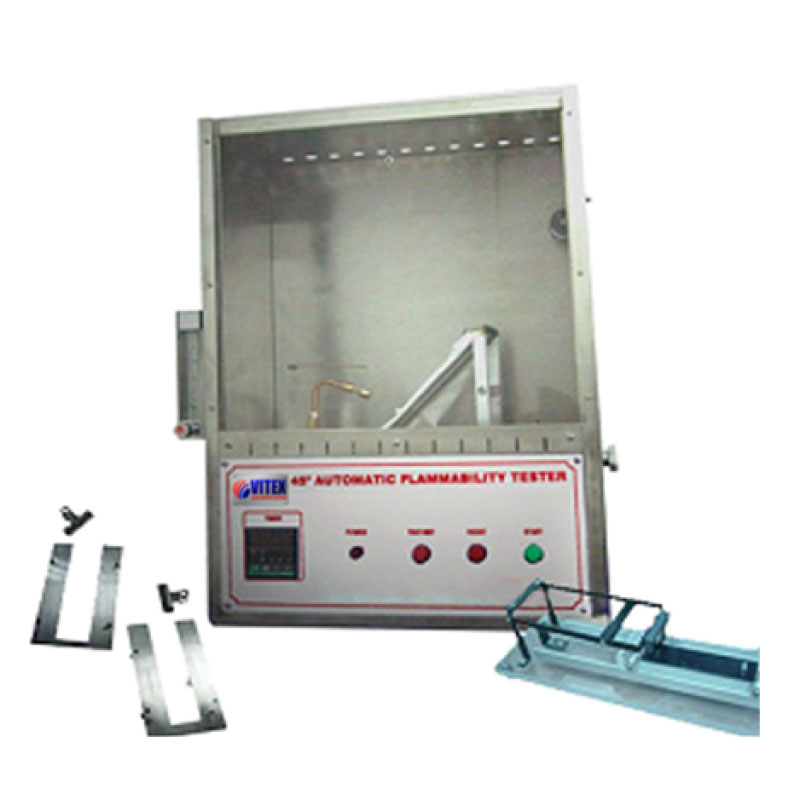
The 45 Degree Flammability Tester is designed to assess fabric flammability under controlled conditions. It includes an automatic igniter to ensure safe and easy operation. The tester features a stainless steel test cabinet with a glass observation panel, which allows for automatic timing of flame spread in 0.1-second increments starting from ignition. This device is suitable for testing the flammability of various fabrics, including clothing, decorative fabrics, and tent fabrics, in accordance with ASTM and FTMS standards.

Specification

Included Accessories

  • 1 Brushing Device
  • 1 No. 50 Sewing Thread
  • 5 Sets of Sample Holders

Standards

  • ASTM D1230
  • FTMS191-5908
  • 16 CFR -1610
  • CALIF TB117

Specifications

  • Power: 220 / 110 V, 50/60 Hz, 2 A
  • Weight: 35 kg
  • Dimensions: 400 x 300 x 500 mm (L x W x H)
  • Time Display and Accuracy: 0-999.9s, 0.1s
  • Ignition Time: 1 ± 0.05s
  • Holder Dimensions: Exterior: 205 x 76 mm, Interior: 165 x 40 mm
  • Distance from Nozzle to Specimen: 8 mm

Testing Method

Test Principle
The 45 Degree Flammability Tester consists of a combustion chamber and a control system. The fabric sample is placed at a 45° angle on a specimen rack inside the combustion chamber. The nozzle ignites the sample with a flame for a set time, and the flame spread is observed. The time it takes for the flame to spread determines the fabric’s flammability rating. This test method is suitable for evaluating the flammability of various types of fabric in line with ASTM and FTMS standards.

Sample Preparation

  1. Dry Cleaning: Follow the 45-degree dry cleaner instruction or ASTM dry clean method.
  2. Washing: Gently knead the dry-cleaned samples in soft water for 5 minutes, rinse twice in 80°F water, and dry. After cleaning, the sample dimensions should be 50.8mm x 152.4mm (2 x 6 inches).
  3. Brushing and Drying: Brush the sample in the opposite direction of the fibers (if present) both before and after cleaning. Place the sample in an oven at 221°F (105°C) for 30 minutes to dry, then cool it in an anhydrous calcium chloride cabinet.

Flammability Test Procedure

  1. Attach the sample to the frame clamp, ensuring an 8 mm distance between the fire nozzle and the sample surface.
  2. Set the ignition and flame spread times, then press the ENT button to save the settings.
  3. Attach the stop-moving hammer to the wing using a cotton rope through the leading pole.
  4. Ignite the burner and adjust the flame gauge to ensure the frame length is 16mm.
  5. Start the test. The flame contacts the sample, and the timer begins. The timer stops once the rope is burned and the sample’s flame propagation time is recorded.
  6. Test five samples and calculate the average burning time. If the burning time is less than 4 seconds or the samples don’t burn, test five more samples and average the results from all 10 samples.

Maintenance

  • Avoid impacts or bending the fire nozzle, as this can affect the test results.
  • Keep the weight hammer switch at an appropriate height to protect the stop switch.
  • Regularly clean burning material residues, the sample clamp, and the interior of the cabinet.
  • Check the airtight gas path to prevent leakage that could affect test results or cause safety hazards.
  • Store the instrument in dry conditions to prevent rusting, and carry out regular anti-rust treatment.
  • Keep the tester in a well-ventilated area to maintain safety during testing.

Coming Soon

Application

The 45 Degree Flammability Tester is designed to assess fabric flammability under controlled conditions. It includes an automatic igniter to ensure safe and easy operation. The tester features a stainless steel test cabinet with a glass observation panel, which allows for automatic timing of flame spread in 0.1-second increments starting from ignition. This device is suitable for testing the flammability of various fabrics, including clothing, decorative fabrics, and tent fabrics, in accordance with ASTM and FTMS standards.

Specification

Included Accessories

  • 1 Brushing Device
  • 1 No. 50 Sewing Thread
  • 5 Sets of Sample Holders

Standards

  • ASTM D1230
  • FTMS191-5908
  • 16 CFR -1610
  • CALIF TB117

Specifications

  • Power: 220 / 110 V, 50/60 Hz, 2 A
  • Weight: 35 kg
  • Dimensions: 400 x 300 x 500 mm (L x W x H)
  • Time Display and Accuracy: 0-999.9s, 0.1s
  • Ignition Time: 1 ± 0.05s
  • Holder Dimensions: Exterior: 205 x 76 mm, Interior: 165 x 40 mm
  • Distance from Nozzle to Specimen: 8 mm

Testing Method

Test Principle
The 45 Degree Flammability Tester consists of a combustion chamber and a control system. The fabric sample is placed at a 45° angle on a specimen rack inside the combustion chamber. The nozzle ignites the sample with a flame for a set time, and the flame spread is observed. The time it takes for the flame to spread determines the fabric’s flammability rating. This test method is suitable for evaluating the flammability of various types of fabric in line with ASTM and FTMS standards.

Sample Preparation

  1. Dry Cleaning: Follow the 45-degree dry cleaner instruction or ASTM dry clean method.
  2. Washing: Gently knead the dry-cleaned samples in soft water for 5 minutes, rinse twice in 80°F water, and dry. After cleaning, the sample dimensions should be 50.8mm x 152.4mm (2 x 6 inches).
  3. Brushing and Drying: Brush the sample in the opposite direction of the fibers (if present) both before and after cleaning. Place the sample in an oven at 221°F (105°C) for 30 minutes to dry, then cool it in an anhydrous calcium chloride cabinet.

Flammability Test Procedure

  1. Attach the sample to the frame clamp, ensuring an 8 mm distance between the fire nozzle and the sample surface.
  2. Set the ignition and flame spread times, then press the ENT button to save the settings.
  3. Attach the stop-moving hammer to the wing using a cotton rope through the leading pole.
  4. Ignite the burner and adjust the flame gauge to ensure the frame length is 16mm.
  5. Start the test. The flame contacts the sample, and the timer begins. The timer stops once the rope is burned and the sample’s flame propagation time is recorded.
  6. Test five samples and calculate the average burning time. If the burning time is less than 4 seconds or the samples don’t burn, test five more samples and average the results from all 10 samples.

Maintenance

  • Avoid impacts or bending the fire nozzle, as this can affect the test results.
  • Keep the weight hammer switch at an appropriate height to protect the stop switch.
  • Regularly clean burning material residues, the sample clamp, and the interior of the cabinet.
  • Check the airtight gas path to prevent leakage that could affect test results or cause safety hazards.
  • Store the instrument in dry conditions to prevent rusting, and carry out regular anti-rust treatment.
  • Keep the tester in a well-ventilated area to maintain safety during testing.
Coming Soon

Save Big on High-Precision Tools!
Get up to 30% off on selected testing machines. Hurry, offer ends soon!
Need Expert Advice?
Speak with our specialists to find the perfect engineering equipment for your needs.

Request a Quote or Further Information

Please fill in the request form below and one of our engineers will contact you to discuss your system requirements and if we can help, our typical response time is within 1 – 3 working day.

What you should know

Well, there's a few conditions that apply:

  • You agree NOT to pay us for this service.
  • You're comfortable with supplying us with relevant information in this form as well as other relevant information surrounding the request, for example; what you want, how many, delivery deadlines, restrictions on the location of the supplier, price targets etc.
  • We may only process requests where the email address submitted matches the company name. We may not respond to free email accounts such as Hotmail.
  • You agree that all information provided in this inquiry form represents yourself or an entity that you can speak for, that the information is accurate to the best of your knowledge and that if we determine that you have given false information we may choose not to proceed with this request.
  • You accept that, the operators of this site, cannot guarantee the suitability of any materials, equipment or services you may purchase from a supplier we've contacted on your behalf. You must check that out with the supplier.
  • We respect your privacy and only pass on the details contained in your request to appropriate suppliers in accordance to your inquiry. As we will share your information with related suppliers, we need your permission to do this by you clicking the submit button. We respect your privacy and promise you will only receive related information in accordance with testing and measuring instruments or equipment news and updates. You can unsubscribe from any of these services at any time by simply forwarding an email to [email protected].
  • We can't guarantee that the supplier will respond and if they don't, you agree you won't get angry with us. However, if you don't receive a response within 10 working days, please send us a follow-up message and we'll try and help further.