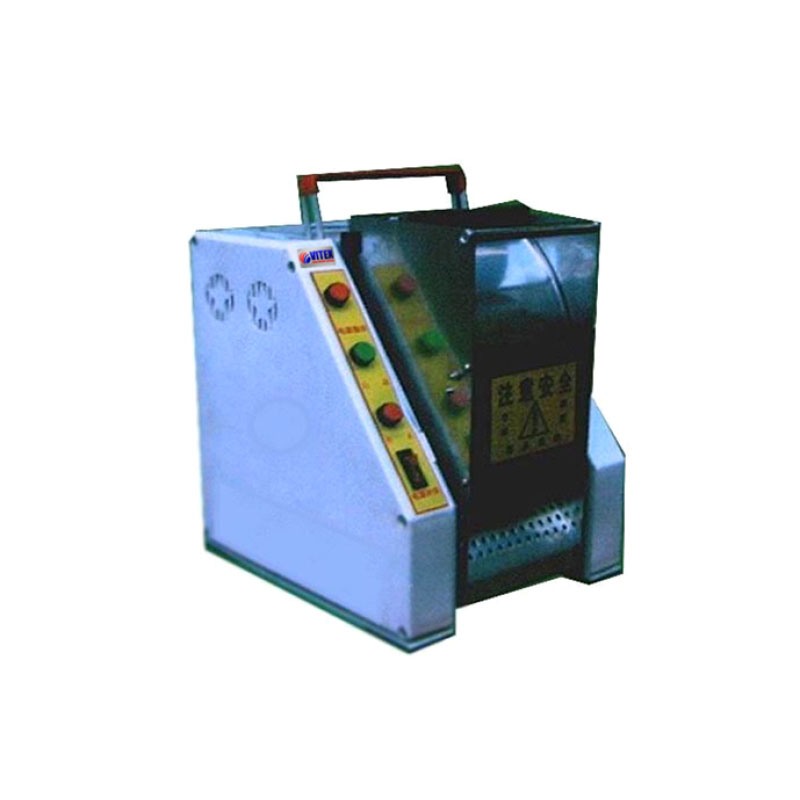
VIT 510A – Portable Laboratory Cotton Gin with Saw Mechanism

[product_tags_no_comma_alt]

Application

The Portable Laboratory Saw Gin is designed for efficiently separating seed cotton in lab environments. After the ginning process, cotton fiber with impurities (such as trash, leaves, and dust) is collected separately, while cottonseed with minimal clean lint is gathered in another container. This lab-specific saw gin is portable and ideal for trial ginning and as a pre-processing step for cotton trash analysis at cotton collection points or laboratories. It is not designed for continuous operation as production equipment.

Features

  • High-efficiency cleaning unit and stable, reliable feeding roller operation
  • Fully enclosed shield for safe operation
  • Compact and lightweight, the smallest model available
  • Equipped with 8 saw blades for effective ginning

Testing Method

Preparation Before Operation

  • Check the drive belt for proper adjustment and stability. Ensure the brush roller operates normally.
  • Inspect the saw roller for proper function, ensuring no collisions with the ribs. Remove any obstructions in the rib top and bottom and the top hole.
  • Ensure the cottonseed board is flat and adjusts flexibly.
  • Perform an idling test to check the machine’s functionality for around 5 minutes. If it operates normally without unusual sounds, proceed with the operation.

Running Test

  • Before starting, ensure the cotton roll box is properly closed. Place a mixture of seed cotton and cottonseed into the cotton box, filling more than half the box.
  • Slowly open the box, start the motor, and push the working box after the machine operates normally. Once the cotton ring feeds properly, the machine is in operation.

Ginning Operation

  • Feed the cotton evenly, ensuring the feeding bucket maintains a sufficient amount of cottonseed.
  • Adjust feeding quantities based on cotton seed tightness; increase feed for looser cotton, decrease for tighter cotton. For cotton with excess moisture, reduce feed to avoid clumping.
  • Regularly check for blockages in the lint tract and cottonseed board to maintain proper burr rate.
  • Stop immediately if any unusual smell is detected to prevent fire hazards.

Specification

Standards
Complies with:

  • JB-T 7884.1

Specifications

  • Power: 220V, 50 Hz, 0.28 kW
  • Weight: 22 kg
  • Dimensions: 270 x 220 x 310 mm (L x W x H)

Coming Soon

Application

The Portable Laboratory Saw Gin is designed for efficiently separating seed cotton in lab environments. After the ginning process, cotton fiber with impurities (such as trash, leaves, and dust) is collected separately, while cottonseed with minimal clean lint is gathered in another container. This lab-specific saw gin is portable and ideal for trial ginning and as a pre-processing step for cotton trash analysis at cotton collection points or laboratories. It is not designed for continuous operation as production equipment.

Features

  • High-efficiency cleaning unit and stable, reliable feeding roller operation
  • Fully enclosed shield for safe operation
  • Compact and lightweight, the smallest model available
  • Equipped with 8 saw blades for effective ginning

Testing Method

Preparation Before Operation

  • Check the drive belt for proper adjustment and stability. Ensure the brush roller operates normally.
  • Inspect the saw roller for proper function, ensuring no collisions with the ribs. Remove any obstructions in the rib top and bottom and the top hole.
  • Ensure the cottonseed board is flat and adjusts flexibly.
  • Perform an idling test to check the machine’s functionality for around 5 minutes. If it operates normally without unusual sounds, proceed with the operation.

Running Test

  • Before starting, ensure the cotton roll box is properly closed. Place a mixture of seed cotton and cottonseed into the cotton box, filling more than half the box.
  • Slowly open the box, start the motor, and push the working box after the machine operates normally. Once the cotton ring feeds properly, the machine is in operation.

Ginning Operation

  • Feed the cotton evenly, ensuring the feeding bucket maintains a sufficient amount of cottonseed.
  • Adjust feeding quantities based on cotton seed tightness; increase feed for looser cotton, decrease for tighter cotton. For cotton with excess moisture, reduce feed to avoid clumping.
  • Regularly check for blockages in the lint tract and cottonseed board to maintain proper burr rate.
  • Stop immediately if any unusual smell is detected to prevent fire hazards.
Specification

Standards
Complies with:

  • JB-T 7884.1

Specifications

  • Power: 220V, 50 Hz, 0.28 kW
  • Weight: 22 kg
  • Dimensions: 270 x 220 x 310 mm (L x W x H)

Coming Soon

Save Big on High-Precision Tools!
Get up to 30% off on selected testing machines. Hurry, offer ends soon!
Need Expert Advice?
Speak with our specialists to find the perfect engineering equipment for your needs.

Request a Quote or Further Information

Please fill in the request form below and one of our engineers will contact you to discuss your system requirements and if we can help, our typical response time is within 1 – 3 working day.

What you should know

Well, there's a few conditions that apply:

  • You agree NOT to pay us for this service.
  • You're comfortable with supplying us with relevant information in this form as well as other relevant information surrounding the request, for example; what you want, how many, delivery deadlines, restrictions on the location of the supplier, price targets etc.
  • We may only process requests where the email address submitted matches the company name. We may not respond to free email accounts such as Hotmail.
  • You agree that all information provided in this inquiry form represents yourself or an entity that you can speak for, that the information is accurate to the best of your knowledge and that if we determine that you have given false information we may choose not to proceed with this request.
  • You accept that, the operators of this site, cannot guarantee the suitability of any materials, equipment or services you may purchase from a supplier we've contacted on your behalf. You must check that out with the supplier.
  • We respect your privacy and only pass on the details contained in your request to appropriate suppliers in accordance to your inquiry. As we will share your information with related suppliers, we need your permission to do this by you clicking the submit button. We respect your privacy and promise you will only receive related information in accordance with testing and measuring instruments or equipment news and updates. You can unsubscribe from any of these services at any time by simply forwarding an email to [email protected].
  • We can't guarantee that the supplier will respond and if they don't, you agree you won't get angry with us. However, if you don't receive a response within 10 working days, please send us a follow-up message and we'll try and help further.