
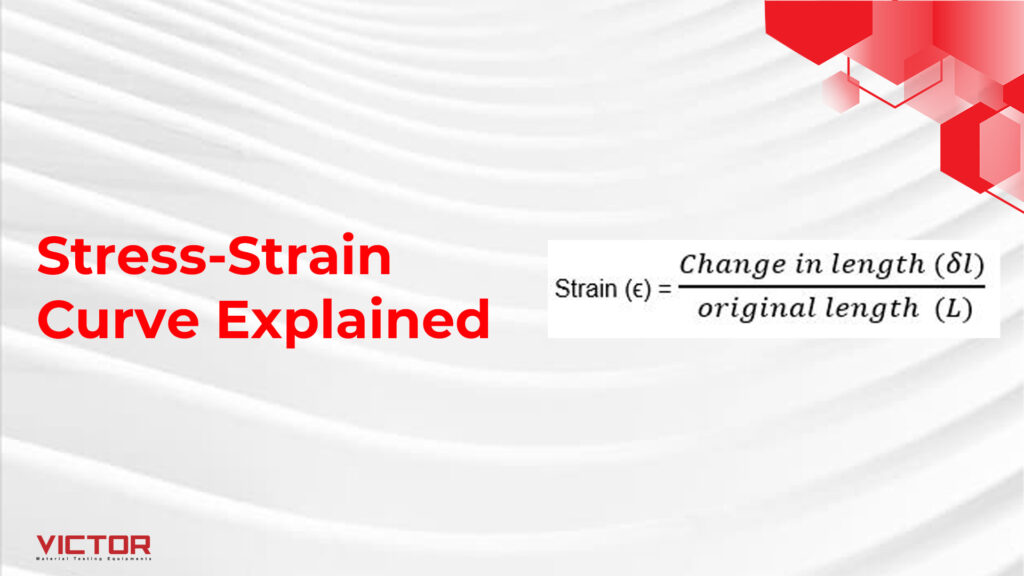
What is a Stress-Strain Curve?
The stress-strain curve is a key graph in material testing used to analyze mechanical properties. It is generated by applying increasing force to a test specimen and measuring the resulting deformation, providing insight into the material’s Young’s modulus, yield strength, and ultimate tensile strength.
What is Stress?
Stress is the internal resistance to deformation, calculated as the force applied divided by the cross-sectional area of the material. It can be tensile (stretching) or compressive (squeezing).
What is Strain?
Strain measures the amount of deformation relative to the original dimensions of the material. It can also be tensile (elongation) or compressive (shortening).
How Stress and Strain Relate
The application of force generates both stress and strain. As force is applied, internal stresses develop, potentially leading to permanent changes in material shape.
Plotting a Stress-Strain Curve
Using a UTM, the specimen undergoes a controlled test, and the force-strain data points are plotted to form the stress-strain curve.
Key Points on the Stress-Strain Curve
- Proportional Limit: Where stress and strain are linearly related.
- Elastic Limit: The point beyond which permanent deformation occurs.
- Yield Point: When plastic deformation begins.
- Ultimate Stress Point: The maximum stress the material can withstand before breaking.
- Fracture Point: Where the material fails.
Types of Stress-Strain Curves for Different Materials
- Brittle Materials: Fracture shortly after the yield point with minimal elongation.
- Ductile Materials: Show significant elongation before fracture.
- Metallic Materials: Exhibit a clear yield point and plastic deformation.
- Plastic Materials: Have less defined yield points and may deform significantly before breaking.
Conclusion
The stress-strain curve is essential for understanding the mechanical properties of materials used in construction, automotive, and aerospace industries.