
What is ASTM D3163?
ASTM D3163 is an international test standard designed to determine the lap-shear strength of adhesively bonded rigid plastic joints. This method is commonly used to:
✔ Compare the shear strength of different adhesive bonds on plastics.
✔ Evaluate surface treatments for improving adhesion.
✔ Ensure reliable quality control in plastic bonding applications.
Accurate shear testing requires grips that compensate for the lap-joint offset, ensuring reliable results.
ASTM D3163 Testing Setup
Test Specimen
🟢 Material: Rigid plastic.
Grips & Fixtures
Different grip options can be used depending on material and test conditions:
✅ Pneumatic Grips –
Adjustable for precise alignment, ensuring the lap joint remains centered. Quick-change jaw faces allow easy material swapping.
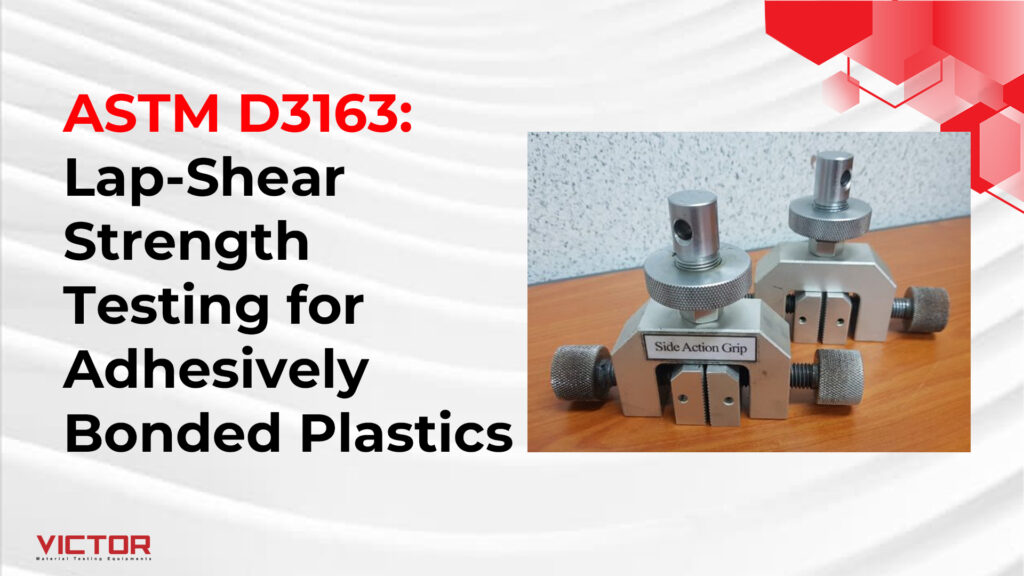
✅ Side-Action Grips –
Suitable for plastics, textiles, rubber, films, and metal samples.
Recommended Universal Testing Machines (UTM)
For ASTM D3163, we recommend UTM machines with a capacity of 2kN to 20kN, depending on the plastic’s strength.
VEW 2307 – Desktop Microcomputer UTM
✔ Compact and lightweight design, easy to move.
✔ Computer-controlled with automatic reporting.
✔ Ideal for quality control and production line testing.
VEW 2308 – Versatile Universal Testing Machine
✔ High-precision electronic motor with five-speed settings.
✔ Supports tensile, compression, shear, peeling, and tearing tests.
✔ Suitable for rubber, plastics, metal, nylon wire, paper, aerospace, and automotive materials.
ASTM D3163 Test Procedure
1️⃣ Prepare and cut the plastic specimens according to ASTM D3163 guidelines.
2️⃣ Apply adhesives as per manufacturer instructions.
3️⃣ Insert specimens into the grips of a tensile testing machine, ensuring proper vertical alignment.
4️⃣ Apply tensile load at the specified stress rate.
5️⃣ Continue loading until failure occurs.
6️⃣ Record the maximum stress and failure type
Key Measurement in ASTM D3163
📌 Maximum Stress (Shear Strength of Adhesive Bond)