
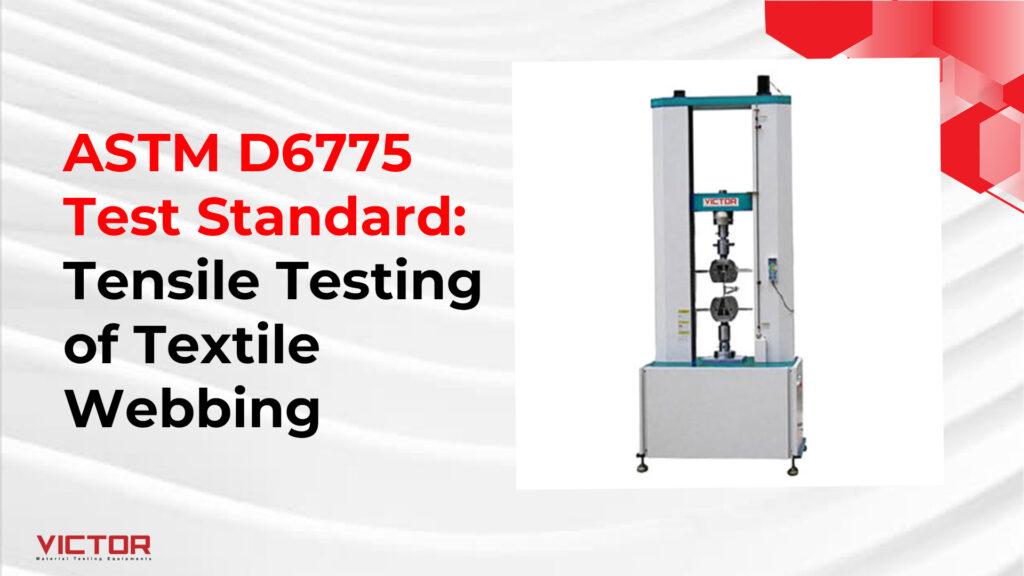
ASTM International is a globally recognized standards organization based in the United States. It develops and publishes technical standards for a wide range of materials, products, systems, and services. One of the commonly used ASTM standards in the industry is ASTM D6775.
Overview of ASTM D6775
ASTM D6775 is an international test standard designed to determine the breaking strength and elongation of textile webbing and similar braided materials. This test is comparable to the Federal Test Method 191A, Section 4108. To conduct this test, a webbing capstan grip is required, which is widely used for securing webbing, straps, and other textile materials.
This test method applies to materials with:
- A maximum width of 90 mm (3.5 inches)
- A maximum breaking strength of 89,000 N (20,000 lb)
Industries such as textiles, transportation, and safety equipment manufacturing frequently use this standard. Seatbelts and tie-down straps used in shipping and transportation are commonly tested under ASTM D6775.
Key Properties Measured
- Breaking Force
- Elongation
Test Specimens
- Webbing and braided textile materials
Grips for ASTM D6775
- Webbing capstan grip
Recommended Testing Machine
A Universal Testing Machine (UTM) with a capacity of 50kN to 100kN is recommended, depending on the material strength. A dual-column floor-type machine is preferable.
Example UTM Machine: VEW 2302
The VEW 2302 Computer Servo Type Universal Testing Machine integrates electronic technology with mechanical transmission, ensuring:
- Accurate load speed and force measurement
- High sensitivity in load, displacement, and control
- Various testing modes such as constant-velocity loading and displacement control
Main Functions
This machine is designed for testing both metallic and non-metallic materials under:
- Tension
- Compression
- Bending
- Shear
- Peel/Tear
- Two-point extensions
Materials commonly tested include:
- Rubber
- Plastic
- Wire & cable
- Optical fiber
- Safety belts
- Leather composites
- Waterproof membranes
- Metals such as steel, copper, and stainless steel
Test Procedure
- Prepare the specimens as described in the method, ensuring the full width of the webbing is used.
- Load and secure the sample into webbing capstan grips. The gauge length (distance between grips) must follow the testing standard.
- Clamp the specimen, securing the top grip first, followed by the bottom grip.
- Align the specimen properly.
- Set the distance between grips to 10 inches.
- Zero the testing machine before starting.
- Apply a slight preload to remove slack and ensure proper grip alignment.
- Apply provisions for measuring elongation as per the standard.
- Begin the test at a constant rate until the specimen fails or breaks.