
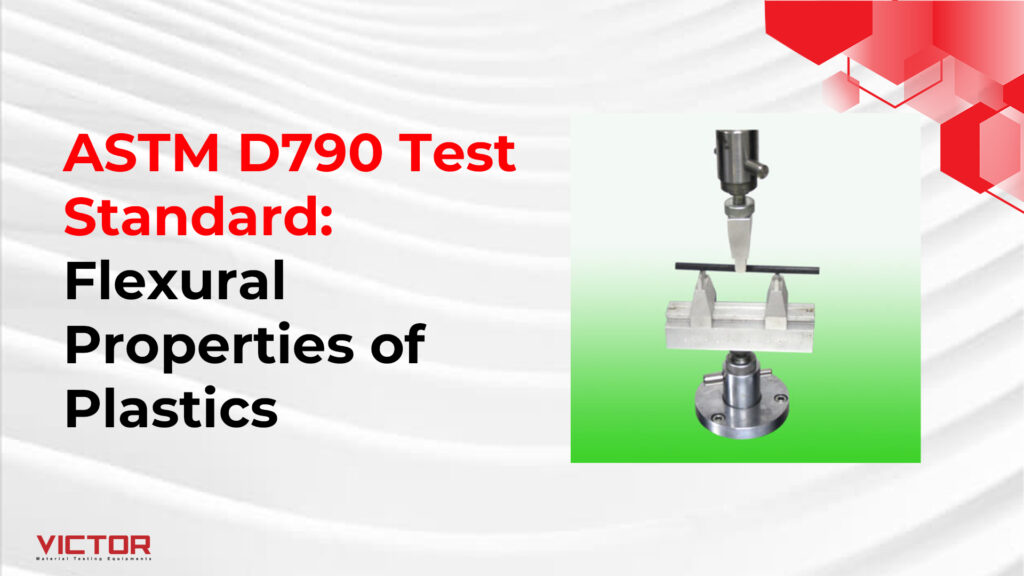
Overview of ASTM D790
ASTM D790 is an international test standard used to determine the flexural properties (bending properties) of both reinforced and unreinforced plastics, as well as electrical insulation materials. These test methods apply to rigid and semi-rigid materials and utilize a three-point loading system applied to a simply supported beam.
This test is essential for evaluating material stiffness, ensuring that the selected materials can withstand applied loads without excessive bending. The plastics industry frequently employs this standard, especially as plastics are increasingly used in structural applications like automotive and aerospace due to their strength and lightweight properties.
ASTM standards are widely preferred by both corporate and government entities. In Malaysia, most industries adhere to ASTM D790, and the Malaysian government has also adopted this standard.
Properties Measured by ASTM D790
ASTM D790 measures the flexural properties of materials under bending strain or deflection. It includes two distinct test procedures:
- Procedure A:
Uses a strain rate of 0.01 mm/mm/min (preferred method). - Procedure B:
Uses a strain rate of 0.10 mm/mm/min for materials that may not break at 5% strain when tested at the lower rate.
This test is conducted using a Universal Testing Machine (UTM) and measures the following properties:
- Tangent modulus
- Secant modulus
- Chord modulus
- Flexural strength
- Flexural stress at break
Test Specimens
Material: Plastic materials
Grips and Fixtures
Type: 3-Point Bending Fixture
The three-point bending test setup consists of a fixture mounted on an electromechanical material testing machine. The fixture relies on the test machine to maintain alignment between the upper and lower parts. This test is ideal for assessing the elastic and ductile properties of materials.
Recommended UTM Machine
We recommend using UTM machines with a capacity of 5kN-100kN, depending on material strength. Dual-column types are preferred for accuracy.
1. VEW 2308
This machine integrates mechanical and electrical components, including:
- Force-measuring sensor
- Transmitter
- Microprocessor
- Load drive mechanism
- Computer interface with color inkjet printer
Applicable Test Methods:
- Tensile
- Compression
- Bending
- Shear
- Peeling
- Tearing
- Crack propagation
Industry Applications:
- Rubber
- Plastics
- Leather
- Metal
- Fabric
- Aerospace
- Packaging
- Construction
- Petrochemical
- Electrical
- Automotive
2. VEW 2302
The VEW 2302 Computer Servo Type UTM combines electronic technology and mechanical transmission for precise load speed and force measurement. It ensures high accuracy in load, displacement measurement, and control, making it ideal for quality control in production lines.
Key Functions:
- Tests metallic and non-metallic materials for tension, compression, bending, shear, peel, and tear.
- Suitable for materials such as rubber, plastic, wire, cable, composite materials, waterproof membranes, and high-hardness steels.
Test Procedure
- Prepare the specimen as per the standard.
- Set up the 3-point bending test using two lower anvils for support and a single upper anvil to apply compressive load.
- Adjust the support span length as specified in the standard.
- Place the test bar on the 3-point bend fixture.
- Ensure proper alignment of the specimen.
- Zero all testing machine settings before initiating the test.
- Begin the test at the specified strain rate.
- End the test once the sample bends to 5% strain or breaks.
This test is crucial for assessing material performance under flexural stress, ensuring optimal material selection for various applications.