
What is ASTM D1621?
ASTM D1621 is an internationally recognized test standard designed to determine the compressive properties of rigid cellular materials, particularly expanded plastics and foams. This test method is widely used across various industries, including construction, automotive, and packaging, to evaluate material performance under compressive loads.
Importance of ASTM D1621 in Industry
Rigid cellular materials like plastics and foams are commonly used in applications requiring structural integrity under pressure. The ASTM D1621 test helps manufacturers assess a material’s ability to withstand compression, making it crucial for product development and quality control.
Industries such as construction rely on this standard to ensure that materials used for insulation, wall installations, and roofing systems can endure mechanical stress without failure. In Malaysia, ASTM D1621 is widely adopted by both corporate and government bodies, ensuring compliance with international material testing standards.
Specimen Preparation for ASTM D1621 Testing
Test specimens for ASTM D1621 must be carefully prepared to ensure accuracy in results. The recommended specimen dimensions are:
- Shape: Square or circular cross-section
- Size: Between 4 and 36 square inches
- Height: Minimum 1 inch, not exceeding the specimen’s width or diameter
- Surface: Faces must be parallel and perpendicular to the specimen’s sides
Key Properties Measured in ASTM D1621
ASTM D1621 testing evaluates several mechanical properties, including:
- Compressive Strength
- Compressive Strain
- Compressive Stress
- Modulus of Elasticity
Testing Equipment for ASTM D1621
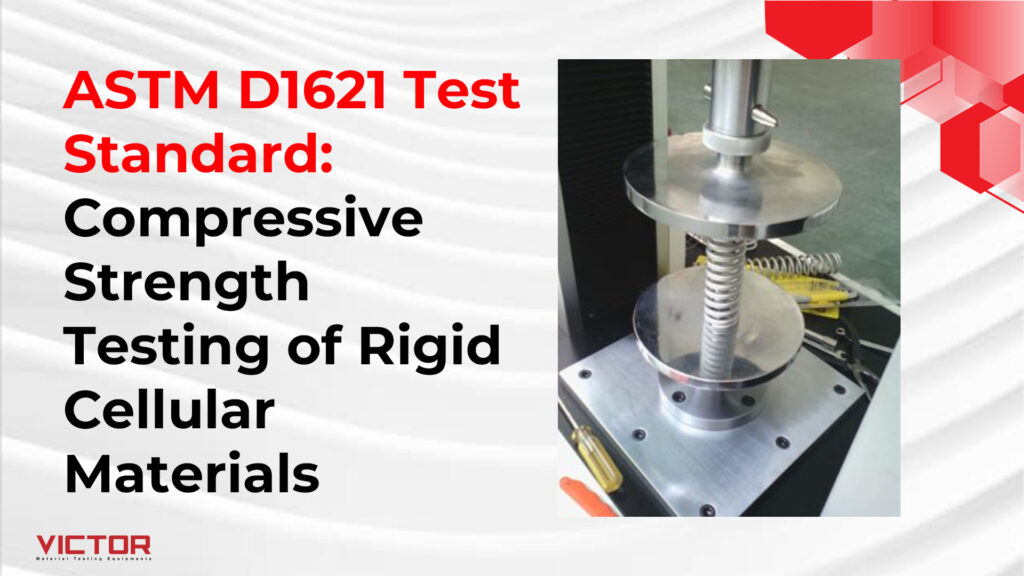
To conduct the ASTM D1621 test, a Universal Testing Machine (UTM) is used. The compression platens must have a flat surface to ensure uniform pressure distribution.
Recommended UTM Specifications:
- Compression platen size: 5 cm – 20 cm
- Machine capacity: 5 kN – 50 kN (depending on material strength)
- Recommended machine type: Dual-column UTM
Common UTM Models for ASTM D1621:
- VEW 2308 – A high-precision electronic motor-driven testing machine designed for multiple mechanical tests, including compression, bending, shear, and tear tests.
- VEW 2302 – A computer-controlled servo-type UTM that provides accurate load speeds and high sensitivity for force and displacement measurements.
ASTM D1621 Test Procedure
- Specimen Preparation: Prepare a test specimen as per ASTM D1621 specifications.
- Positioning the Specimen: Place the specimen between compression plates, ensuring proper alignment.
- Deflectometer Attachment: Attach a deflectometer to measure deformation.
- Adjust Crosshead: Lower the crosshead until it contacts the specimen.
- Apply Compressive Force:
- Apply a compressive force at a crosshead displacement rate of 2.5 mm/min per 25.4 mm of specimen thickness.
- Stop the test when the sample is compressed by 13% of its height.
- Record Data: Collect force and deformation data to determine compressive strength.
Measurement and Interpretation of Results
- If no yield point is observed, report the force at 10% deformation.
- If a yield point is observed, record the force and deformation percentage at that point.
Conclusion
The ASTM D1621 test is essential for evaluating the compressive properties of rigid cellular materials. By following the correct procedures and using standardized equipment, manufacturers can ensure product reliability and compliance with industry standards.
ASTM D7269 Test Standard: Tensile Testing of Aramid Yarns
ASTM D7269 ASTM D7269 is an international test standard designed for evaluating the tensile properties of aramid yarns, cords made from such yarns, and fabrics woven from these cords. This test method is widely used in industries that require high-performance fibers, such as aerospace, automotive, and protective textiles.
This standard specifically applies to aramid fibers like Kevlar and covers multiple procedures for testing yarns and fabrics in different forms, including individual fibers, wound yarns, and woven fabrics. The appropriate testing method depends on the form of the specimen.
ASTM D7269 vs. ASTM D2256
While ASTM D2256 assesses the tensile properties of yarns using the single-strand method, ASTM D7269 is tailored for aramid yarns and employs a 50% extension rate relative to the sample length. In contrast, ASTM D2256 applies a 12-inch per minute extension rate using a 10-inch sample length.
Why ASTM D7269 is Important
ASTM D7269 is preferred by many industries and regulatory bodies worldwide, including in Malaysia, where both corporate and government sectors have widely adopted this standard. This test method helps ensure consistency and reliability in the mechanical properties of aramid fibers used in various applications.
Key Properties Measured in ASTM D7269
- Tensile Stress
- Tensile Stress at a Given Elongation
- Ultimate Tensile Strength
- Yield Point
- Ultimate Elongation
Test Specimens for ASTM D7269
Material Types
- Aramid Yarns
- Twisted Cords
- Woven Fabrics
Grips Used in ASTM D7269 Testing
Capstan Grip
Capstan grips are the preferred choice for this test as they help reduce clamping pressure while ensuring proper specimen alignment. These grips prevent stress concentration points that could lead to premature failure.
Recommended Universal Testing Machine (UTM) for ASTM D7269
For accurate tensile testing, a Universal Testing Machine (UTM) with a capacity of 5kN-20kN is recommended. Smaller dual-column UTMs are ideal for testing aramid yarns and fabrics.
VEW 2308 UTM
This UTM model integrates mechanical and electrical components to provide accurate force measurements. It supports multiple testing functions, including tension, compression, bending, shear, peeling, and tearing. The VEW 2308 UTM complies with several international testing standards.
Testing Procedure for ASTM D7269
- Prepare the Specimens: Ensure they meet the specified dimensions and form (yarn, cord, or fabric).
- Load the Specimen into the Grip: Secure the top grip first, followed by the bottom grip.
- Measure the Length: Use a caliper or measuring tape to record the specimen’s length before testing.
- Align the Specimen: Ensure proper alignment to prevent premature failure.
- Zero the Machine: Reset the UTM to eliminate any prior readings.
- Apply Preload: A small preload may be used to remove slack in the specimen.
- Start the Test: Apply a constant rate of extension until the specimen reaches failure.
- Record the Results: Capture the tensile strength, elongation, and other properties as per ASTM D7269 requirements.