
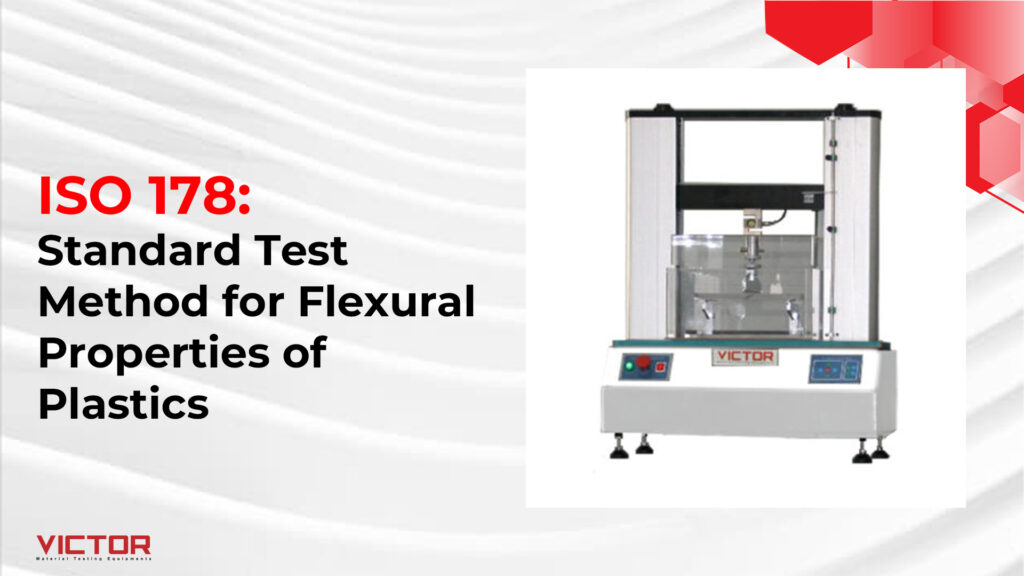
ISO 178 is an internationally recognized test standard developed by the International Organization for Standardization (ISO) to determine the flexural properties of rigid and semi-rigid plastics.
This test evaluates the flexural stress, strain, and modulus of plastic materials by applying a three-point bending test using a Universal Testing Machine (UTM). The results help manufacturers assess the mechanical strength and durability of plastic components.
Why is ISO 178 Important?
- Determines the bending strength of plastics.
- Measures flexural modulus and strain to assess material performance.
- Used across industries including automotive, aerospace, packaging, and construction.
- Ensures product quality, safety, and compliance with international standards.
ISO 178 Test Methods
ISO 178 provides two test methods based on strain rate:
- Method A: Strain rate of 1%/min throughout the test.
- Method B: Two different strain rates:
- 1%/min for determining flexural modulus.
- 5%/min or 50%/min, depending on material ductility, for determining flexural stress-strain properties.
More details: ISO 178 Standard
Test Specimens for ISO 178
Test specimens can have different cross-sectional shapes, including:
- Round
- Square
- Rectangular
- Polygonal
Specimen Preparation:
- Specimens are die-cut, sawn, or injection-molded to meet ISO 178 dimensions.
- Width and thickness should be measured at mid-length before testing.
Jigs & Equipment for ISO 178 Testing
Bending Fixtures for Three-Point Flexural Testing
- Bending Device with Two Supports and a Former
- Mounted on an electromechanical UTM.
- Maintains alignment between top and bottom parts for accurate testing.
- Bending Device with a V-Block and a Former
- Alternative fixture for high-precision bending tests.
Extensometers
This test does not require an extensometer, as elongation is not a key measurement in ISO 178.
Recommended Universal Testing Machine (UTM) for ISO 178
For ISO 178 testing, we recommend UTM machines capable of performing flexural, tensile, and compression tests.
1. VEW 2308 Series – Universal Testing Machine
Features:
- Computer-controlled with high-precision electronic motor.
- Can perform flexural, tensile, compression, shear, peeling, and tearing tests.
- Designed for plastics, rubber, leather, fabric, aerospace materials, and more.
2. VEW 2308A – Advanced Universal Testing Machine
- Similar to the VEW 2308 but with additional automation and precision control.
- Suitable for industries requiring high-accuracy material testing.
More details: VEW 2308 Series Universal Testing Machine
ISO 178 Test Procedure
- Prepare the specimens according to ISO 178 specifications.
- Measure width and thickness at the mid-length of each specimen.
- Adjust the support span as specified in the standard based on specimen size.
- Place the specimen on the three-point bending fixture.
- Begin the test at the specified strain rate (1%/min or 5%/min).
- Record force and deflection data throughout the test.
ISO 178 Test Measurements
The test determines:
✅ Flexural Stress (Maximum stress experienced before failure).
✅ Flexural Strain (Deformation of the material under bending).
✅ Flexural Modulus (Material stiffness under bending).