Application
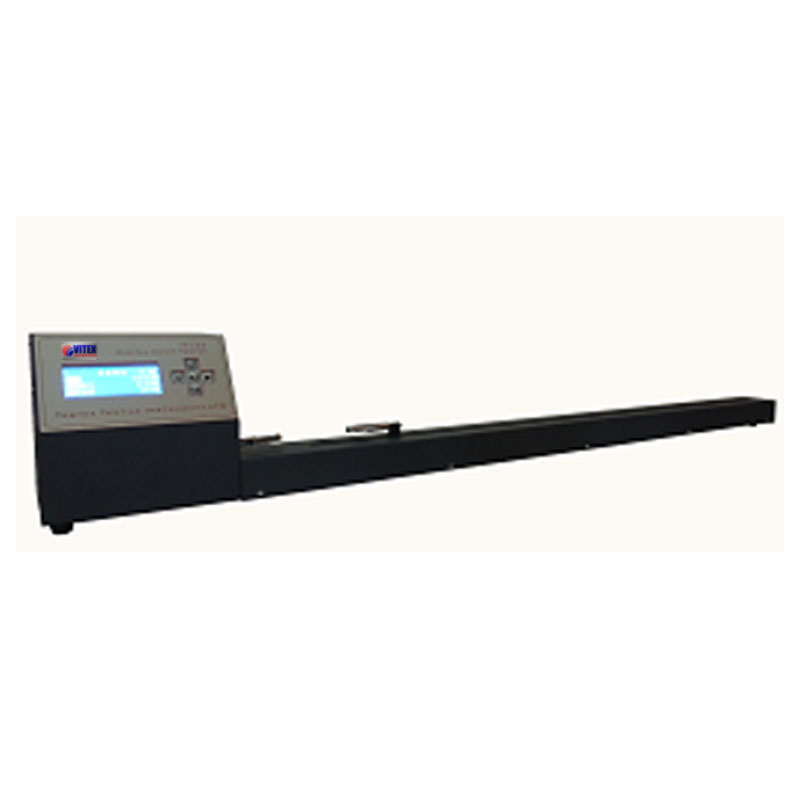
The Yarn Crimp Tester is used to calculate the crimp in yarns affected by knitting or weaving. This is achieved by extracting a sample of yarn from a fabric of a given length, straightening it under a set force, and measuring its length to determine the actual yarn usage.
Specification
Standards
FZ/T 01091, ISO 7211, ASTM D3883, GB/T 25296, FZ/T 01093, FZ/T 70008, IWSTM 169, BS 2863/2865/2866
Power
220 / 110 V 50/60 Hz 200W
Weight
46 kg
Dimensions
1655 x 330 x 300 mm (L x W x H)
Specifications
- Load Range: 0.01 – 200 cN
- Length Sensor Accuracy: 1 mm
- Display: Touch panel
- Stroke (Excluding Grips): 10 – 1000 mm
Testing Method
Definition of Yarn Crimp
Yarn crimp refers to the percentage difference between the straightened length and the curled length of the yarn under a specific load. This value reflects the degree of yarn shrinkage or the yarn’s recovery from its crimped structure when straightened. Yarn crimp is a crucial factor that impacts the amount of yarn used, the appearance of the fabric, and its physical and mechanical properties.
Structural Characteristics of the Yarn Crimp Instrument
The yarn crimp measuring instrument consists of a long base strip with a fixed scale, a pretension setting device, and a length measuring device. The pretension setting device includes a balanced head fixed on the base, with a balance pointer and a moveable weight along a balance rod.
The length measuring device includes two clamps: one mounted on the balance head and the other on a sliding component that moves horizontally along the scale. The instrument also has a calibration device, a large and small balance head, and a two-step measuring range for accurate and efficient crimp measurement.