VMT 412 – Rotary Vertical Crockmeter

[product_tags_no_comma_alt]

Application

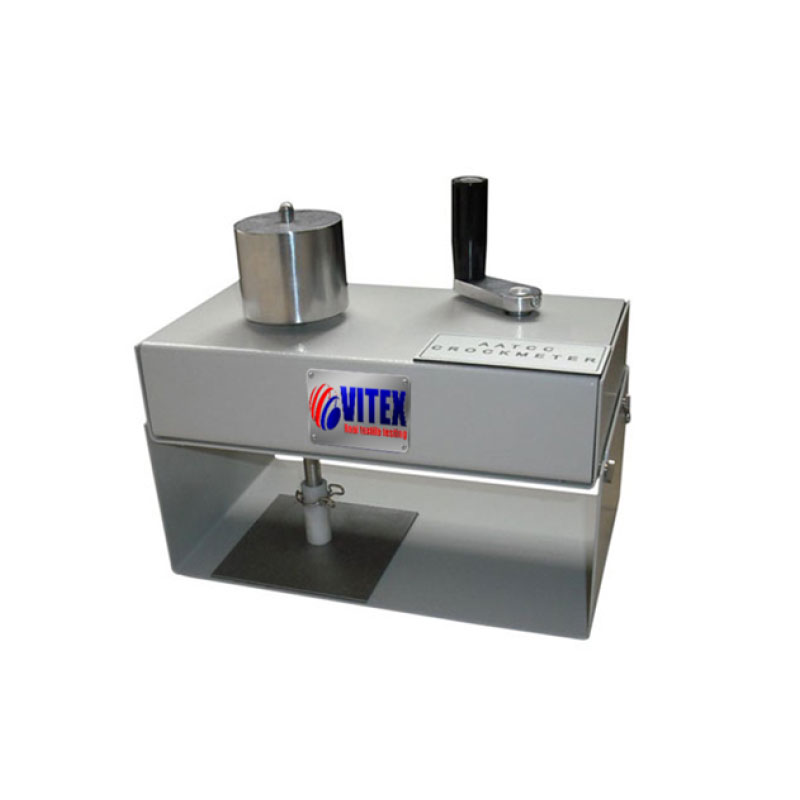
The Rotary Vertical Crockmeter evaluates the color fastness of textiles to dry and wet rubbing, particularly for printed fabrics. It applies 1134 grams of pressure on a 16mm diameter rubbing head, rotating 1.125 turns clockwise and then counterclockwise. The operating handle rotates in one consistent direction, ensuring uniform testing.

Testing Method

Purpose and Scope

This method assesses the degree of color transfer from the surface of colored textiles to other materials due to friction. It is suitable for colored yarns and fabrics of various fibers, including dyed, printed, and other colored textiles. This method is especially effective for testing printed textiles with small areas that standard methods cannot accommodate.

Test Principle

The specimen is fixed on the base of the rotating vertical friction instrument and rubbed with standard friction cloth under specified conditions. The degree of color transfer to the friction cloth is evaluated by comparing it against a stained gray card or an AATCC color card.

Sample Preparation

The specimen should be tailored to a specified area and conditioned before testing. Both the sample and the friction cloth should remain under atmospheric conditions of 21°C ± 1°C and relative humidity of 65% ± 2% for at least four hours.

Dry Friction Test Procedure

  1. Attach the standard friction cloth to the end of the vertical rod and secure it with the spring clip.
  2. Fix the specimen on the instrument base so the friction cloth makes direct contact with the sample.
  3. Apply downward pressure on the friction head with the instrument’s weight.
  4. Hold the specimen steady and rotate the crank to initiate the rubbing motion.
  5. After the specified number of rotations, remove the sample and friction cloth and evaluate the degree of color transfer.

Operational Notice

  • Ensure the friction head surface remains even; an uneven stained pattern suggests it may need resurfacing.
  • Elongated ghost patterns may indicate a loose spiral metal clip.
  • Marks on the specimen’s edge suggest incorrect positioning of the spiral metal clip.
  • Replace friction sandpaper if the friction area becomes smooth or if the sample slides during testing.

Specification

Technical Specifications

  • Rubbing Head Diameter: 16mm
  • Vertical Pressure: 1134g
  • Rotation: 405°
  • Weight 11 kg
  • Dimensions 250 x 150 x 250 mm (L x W x H)

Included Accessories

  • AATCC Rubbing Cloth (1 box)
  • Sandpaper (2 pieces)
  • Rings (2 pieces)

Standards

  • AATCC 116
  • ISO 105 X16

Coming Soon

Application

The Rotary Vertical Crockmeter evaluates the color fastness of textiles to dry and wet rubbing, particularly for printed fabrics. It applies 1134 grams of pressure on a 16mm diameter rubbing head, rotating 1.125 turns clockwise and then counterclockwise. The operating handle rotates in one consistent direction, ensuring uniform testing.

Testing Method

Purpose and Scope

This method assesses the degree of color transfer from the surface of colored textiles to other materials due to friction. It is suitable for colored yarns and fabrics of various fibers, including dyed, printed, and other colored textiles. This method is especially effective for testing printed textiles with small areas that standard methods cannot accommodate.

Test Principle

The specimen is fixed on the base of the rotating vertical friction instrument and rubbed with standard friction cloth under specified conditions. The degree of color transfer to the friction cloth is evaluated by comparing it against a stained gray card or an AATCC color card.

Sample Preparation

The specimen should be tailored to a specified area and conditioned before testing. Both the sample and the friction cloth should remain under atmospheric conditions of 21°C ± 1°C and relative humidity of 65% ± 2% for at least four hours.

Dry Friction Test Procedure

  1. Attach the standard friction cloth to the end of the vertical rod and secure it with the spring clip.
  2. Fix the specimen on the instrument base so the friction cloth makes direct contact with the sample.
  3. Apply downward pressure on the friction head with the instrument’s weight.
  4. Hold the specimen steady and rotate the crank to initiate the rubbing motion.
  5. After the specified number of rotations, remove the sample and friction cloth and evaluate the degree of color transfer.

Operational Notice

  • Ensure the friction head surface remains even; an uneven stained pattern suggests it may need resurfacing.
  • Elongated ghost patterns may indicate a loose spiral metal clip.
  • Marks on the specimen’s edge suggest incorrect positioning of the spiral metal clip.
  • Replace friction sandpaper if the friction area becomes smooth or if the sample slides during testing.

Specification

Technical Specifications

  • Rubbing Head Diameter: 16mm
  • Vertical Pressure: 1134g
  • Rotation: 405°
  • Weight 11 kg
  • Dimensions 250 x 150 x 250 mm (L x W x H)

Included Accessories

  • AATCC Rubbing Cloth (1 box)
  • Sandpaper (2 pieces)
  • Rings (2 pieces)

Standards

  • AATCC 116
  • ISO 105 X16

Coming Soon

Save Big on High-Precision Tools!
Get up to 30% off on selected testing machines. Hurry, offer ends soon!
Need Expert Advice?
Speak with our specialists to find the perfect engineering equipment for your needs.

Request a Quote or Further Information

Please fill in the request form below and one of our engineers will contact you to discuss your system requirements and if we can help, our typical response time is within 1 – 3 working day.

What you should know

Well, there's a few conditions that apply:

  • You agree NOT to pay us for this service.
  • You're comfortable with supplying us with relevant information in this form as well as other relevant information surrounding the request, for example; what you want, how many, delivery deadlines, restrictions on the location of the supplier, price targets etc.
  • We may only process requests where the email address submitted matches the company name. We may not respond to free email accounts such as Hotmail.
  • You agree that all information provided in this inquiry form represents yourself or an entity that you can speak for, that the information is accurate to the best of your knowledge and that if we determine that you have given false information we may choose not to proceed with this request.
  • You accept that, the operators of this site, cannot guarantee the suitability of any materials, equipment or services you may purchase from a supplier we've contacted on your behalf. You must check that out with the supplier.
  • We respect your privacy and only pass on the details contained in your request to appropriate suppliers in accordance to your inquiry. As we will share your information with related suppliers, we need your permission to do this by you clicking the submit button. We respect your privacy and promise you will only receive related information in accordance with testing and measuring instruments or equipment news and updates. You can unsubscribe from any of these services at any time by simply forwarding an email to [email protected].
  • We can't guarantee that the supplier will respond and if they don't, you agree you won't get angry with us. However, if you don't receive a response within 10 working days, please send us a follow-up message and we'll try and help further.