
The International Organization for Standardization (ISO) is an independent, non-governmental organization that develops global standards to ensure quality, safety, and efficiency in products, services, and systems. ISO standards are widely used across industries to improve processes, enhance reliability, and increase global compatibility.
What is ISO 6892-1?
ISO 6892-1 is one of the most commonly used test standards for the tensile testing of metallic materials at room temperature. The latest version of this standard (published in 2016) covers three different test methods:
- Method A1
- Method A2
- Method B
Although ISO 6892-1 and ASTM E8/E8M share similarities, they are not identical.
ISO 6892 Series: Different Testing Temperatures
ISO 6892 is divided into four parts, each specifying a different temperature range:
- ISO 6892-1 – Testing at room temperature
- ISO 6892-2 – Testing at elevated temperature
- ISO 6892-3 – Testing at low temperatures
- ISO 6892-4 – Testing in liquid helium
Test Specimens for ISO 6892-1
Due to the wide range of applications for metallic materials, ISO 6892-1 accepts multiple specimen types:
- Type 1 – Thin sheets, strips, and flats (0.1 mm – 3 mm thick)
- Type 2 – Wire, bars, and sections (diameter/thickness < 4 mm)
- Type 3 – Sheets, flats (≥ 3 mm thick), and wire, bars, sections (diameter/thickness ≥ 4 mm)
What Does ISO 6892-1 Measure?
ISO 6892-1 primarily evaluates the following mechanical properties:
- Yield Strength –
The stress at which a material begins to deform permanently. The standard also defines upper and lower yield strength for discontinuous yielding materials. - Yield Point Elongation –
Measures elongation from the start to the end of the yielding process (for discontinuous yielding materials). - Tensile Strength –
The maximum force or stress a material can withstand before breaking. - Reduction of Area –
Measures a material’s ductility by comparing its original cross-section area to the smallest area after testing.
Grips for ISO 6892-1 Testing
Proper grip selection is crucial for accurate results and specimen alignment to prevent side loading or bending moments. The most commonly used grips include:
- Mechanical Wedge Grips
- Tensile Wedge Grips
- Jaw Tension Clamps
These self-tightening grips provide secure clamping as the tensile test progresses, making them ideal for high-strength metal testing.
Extensometers for ISO 6892-1
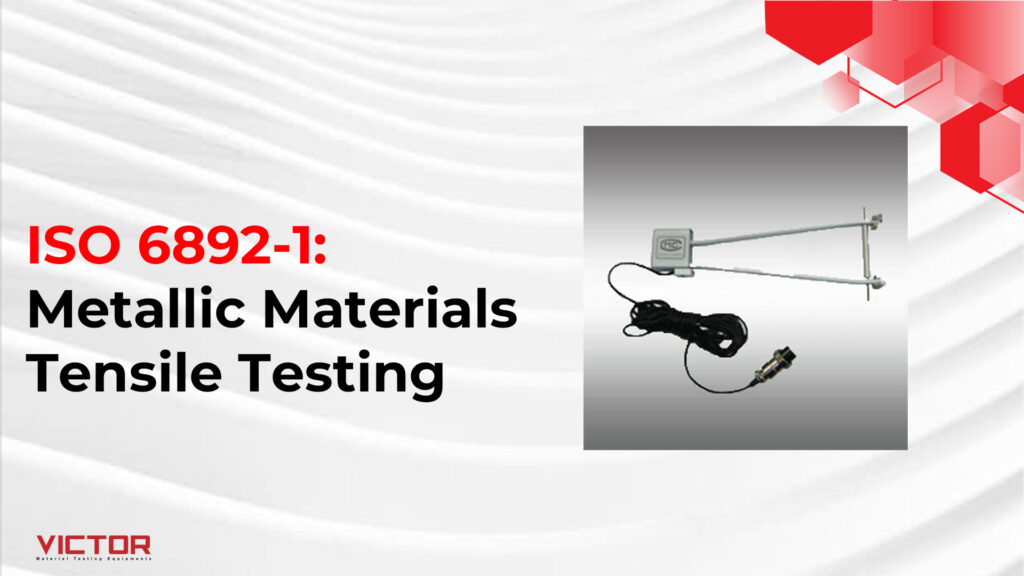
During tensile testing, an extensometer is required for precise deformation measurements. Different extensometers offer varying accuracy levels depending on strain requirements:
- Electronic Extensometers – Used for high-precision strain measurements during tensile tests.
Recommended Universal Testing Machine (UTM) for ISO 6892-1
We recommend UTM machines with a capacity of 50kN–100kN, depending on the material’s strength. A dual-column floor-type UTM is ideal for ISO 6892-1 testing.
Recommended Model: VEW 2302 Series
Features:
- Electronic-mechanical integration for precise load control
- High accuracy and sensitivity for force, displacement, and speed measurements
- Supports constant-velocity loading and displacement testing
This machine is easy to operate and ideal for quality control in production lines.
More details: VEW 2302 Universal Testing Machine
ISO 6892-1 Testing Software
Modern testing equipment includes pre-installed software compatible with ISO 6892-1 to ensure accurate data collection. When selecting software, ensure it aligns with the standard and provides reliable and repeatable results.
ISO 6892-1 Test Procedure
- Prepare the test specimens according to ISO 6892-1 guidelines.
- Secure the specimen into the grips (clamp the top grip first, then the bottom).
- Attach the extensometer to measure strain.
- Zero all testing equipment before starting.
- Start the test using the software interface.
- Continue the test until the specimen breaks.
- Record and analyze test data.
Different equipment brands may have varied grip styles, but the overall testing concept remains the same.