
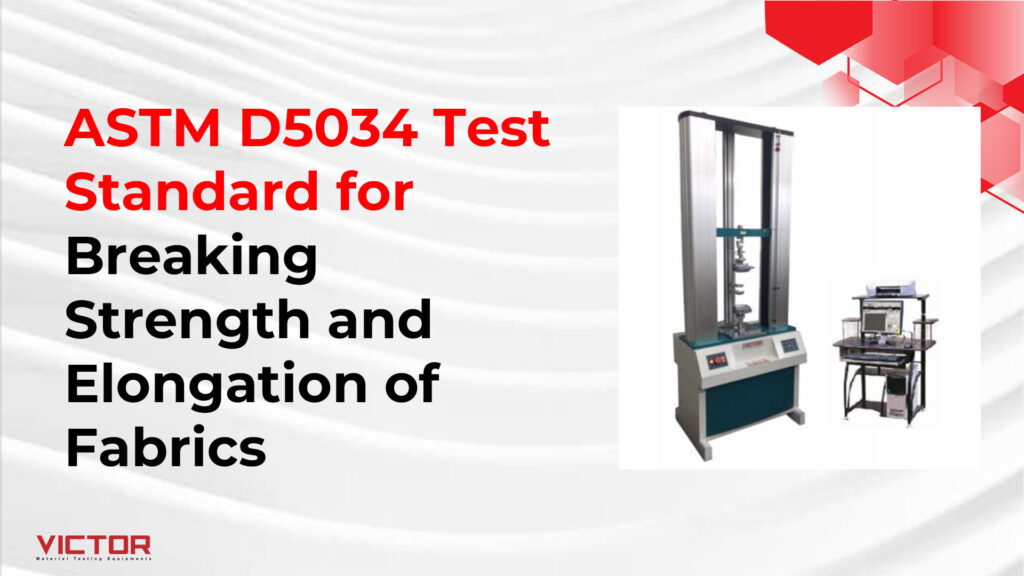
Introduction to ASTM D5034 Test Standard
ASTM International, headquartered in the United States, plays a pivotal role in establishing global standards for materials, products, and systems. One of the key standards is ASTM D5034, designed to measure the breaking strength and elongation of woven, non-woven, and felted fabrics. This test is crucial for evaluating the strength and elasticity of textile materials used in various industries, from apparel to automotive manufacturing.
What is ASTM D5034?
ASTM D5034 offers standardized methods to measure the breaking strength and elongation of fabrics, with grab and modified grab testing procedures. The grab test is for woven, nonwoven, and felted fabrics, while the modified grab test is primarily for woven fabrics. This standard is not suitable for glass fabrics, knitted fabrics, or textiles exhibiting high stretch (more than 11% elongation). Widely adopted in textile and manufacturing industries, it is essential for evaluating materials such as seatbelt webbing, filters, and upholstery fabrics.
Properties Measured by ASTM D5034
The following key properties are assessed during ASTM D5034 testing:
- Breaking Force
- Elongation
- Maximum Load
- Load at Extension Point
These measurements are critical for assessing the strength and stretchability of fabrics in applications like clothing, safety materials, and upholstery.
Specimens for ASTM D5034 Testing
The standard applies to woven, non-woven, and felted fabrics with the following specifications:
- Specimen Width: 100 mm (4.0 in)
- Testing Method: Specimens are mounted and clamped in a Universal Testing Machine (UTM), which applies force until the specimen breaks. Results such as breaking force and elongation are recorded via a computer interface.
Grips for ASTM D5034 Testing
For optimal results, pneumatic or manual grips with rubber-coated inserts are recommended to prevent specimen slippage. Pneumatic grips are preferred for their ease of use and consistent repeatability.
Recommended Universal Testing Machines (UTM)
For ASTM D5034 testing, Universal Testing Machines (UTM) with a load capacity of 5 kN to 20 kN are recommended, depending on the strength of the textile materials. Dual-column floor-type machines are ideal for their precision and stability.
Recommended UTM Model:
- VEW 2308 – A mechanical-electrical integrated UTM, perfect for various testing applications. It can test materials in tensile, compression, bending, shear, and other tests.
ASTM D5034 Test Procedure
Follow these steps for ASTM D5034 testing:
- Prepare the Specimens
Cut the fabric into a rectangular shape, ensuring the longer side aligns with the direction to be tested. - Clamp the Specimen
Secure the specimen into the pneumatic or manual grips, ensuring proper alignment. - Zero the Testing Machine
Zero the testing machine to ensure accurate results. - Preload (Optional)
Apply a slight preload to remove slack from the specimen and ensure alignment. - Start the Test
Begin testing with a constant rate of extension until the specimen breaks. - Record the Results
Document the breaking force and elongation at failure.
Conclusion
ASTM D5034 is essential for determining the breaking strength and elongation of woven, non-woven, and felted fabrics. It is crucial for industries requiring precise fabric testing, including textiles, automotive, and safety manufacturing. By following this standardized procedure, manufacturers can ensure their materials meet strength and durability requirements.